


AI and automation are rapidly changing. ComputerRL has been introduced by Zhipu AIThis framework is a revolutionary tool that empowers agents to manipulate and navigate complex digital environments. This innovative solution addresses one of the core challenges in AI agent design: the gap between human-designed GUIs and computer agents. ComputerRL’s integration of programmatic API calls and direct GUI interaction enables ComputerRL to provide more versatile desktop operations. This is a major step towards autonomous computer agents.

API-GUI Paradigm : Human and machine interaction bridging
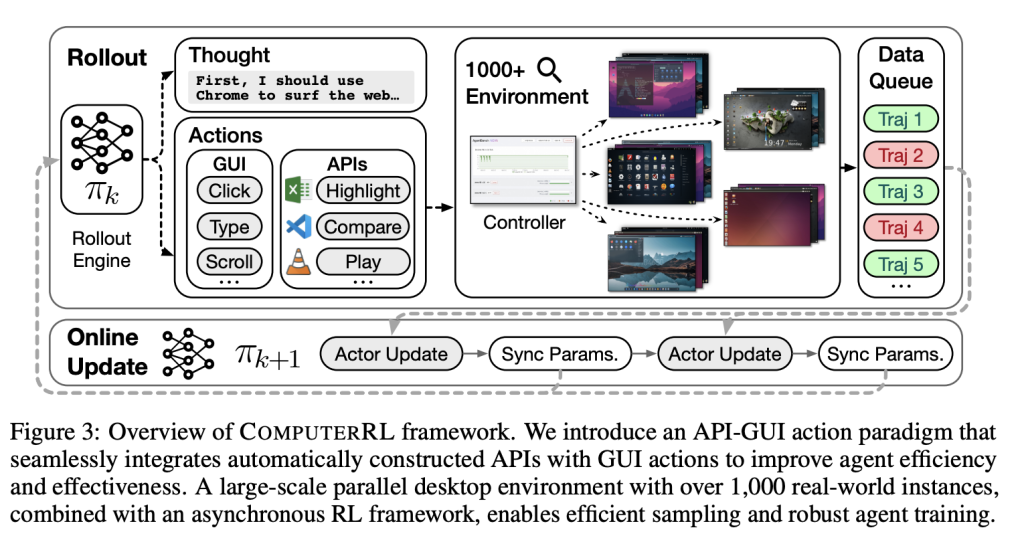
Traditional GUI agents struggle to simulate actions, such as scrolling or clicking. ComputerRL’s API-GUI approach combines APIs precision with GUI flexibility. It is a hybrid method that allows agents to utilize APIs with machine-friendly interfaces when performing tasks which benefit from programmatic controls, but fall back on GUI operations for greater adaptability.
Large language models (LLMs) are used to automate API creation. Users submit example tasks and the system generates testcases, analyzes requirements, creates APIs with relevant Python libraries and then implements them. The APIs are encapsulated with general purpose functionalities. This reduces complexity, and enhances agent performance. As an example, Ubuntu applications, such as GIMP and LibreOffice, are integrated with APIs, making it easier to accomplish tasks, like document formatting or image processing, than using GUI-only methods.
Scalable infrastructure for large-scale RL Training
The inefficiency of virtual environments is one major barrier to desktop agent training. ComputerRL’s distributed reinforcement learning infrastructure, built with Docker and gRPC to support thousands of Ubuntu virtual machine parallels, overcomes the problem. The setup works with AgentBench benchmarks and fixes issues like resource-intensiveness and bottlenecks in previous systems.
The key features are qemu in Docker for lightweight VM deployment, multi-node Clustering to increase scalability and a web-based interface monitoring. When combined with AgentRL, this framework enables asynchronous, fully-automated training. This decouples data collection from parameter changes to increase efficiency. This infrastructure enables high-throughput RL. It also allows dynamic batch sizing with off-policy biased mitigation.
The Entropulse System: Alternating training phases to enhance RL
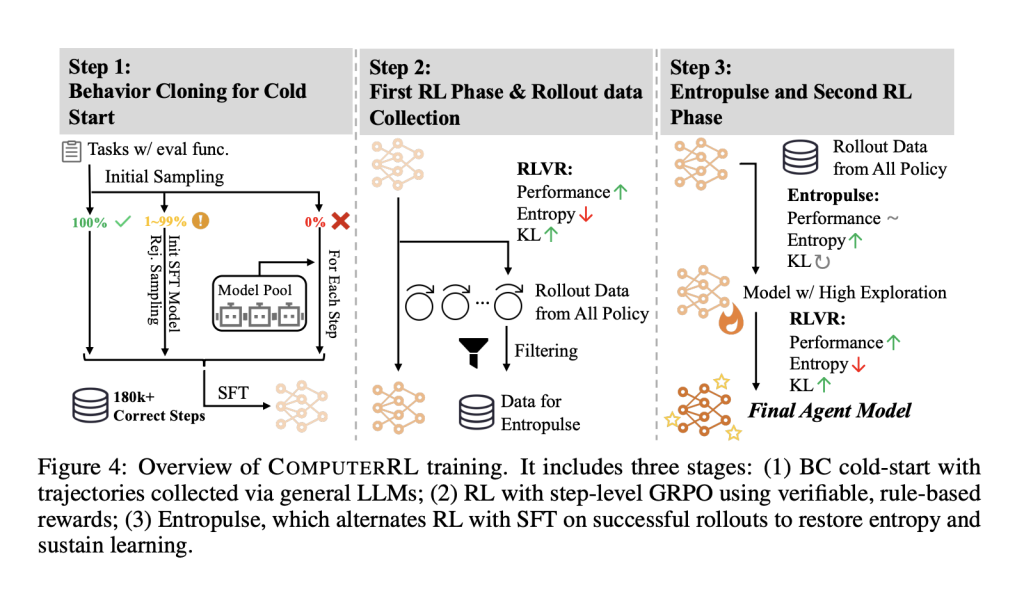
To tackle entropy collapse—a common issue where agents lose exploratory behavior during prolonged RL—ComputerRL incorporates Entropulse. This technique alternates RL with supervised refinement (SFT) at successful rollout trajectories. It restores entropy while enabling sustainable performance gains.
It begins by cloning behavior (BC), using multiple LLMs to create diversity. Then, it applies Group Relative Policy Optimization at a step-level, with rules-based rewards. It only assigns positive scores to actions that are correct and contribute to successful trajectories. Entropulse intercedes by curating diverse and high-quality data for SFT from prior rollouts, preventing premature convergence.
The experimental validation of OSWorld Benchmark
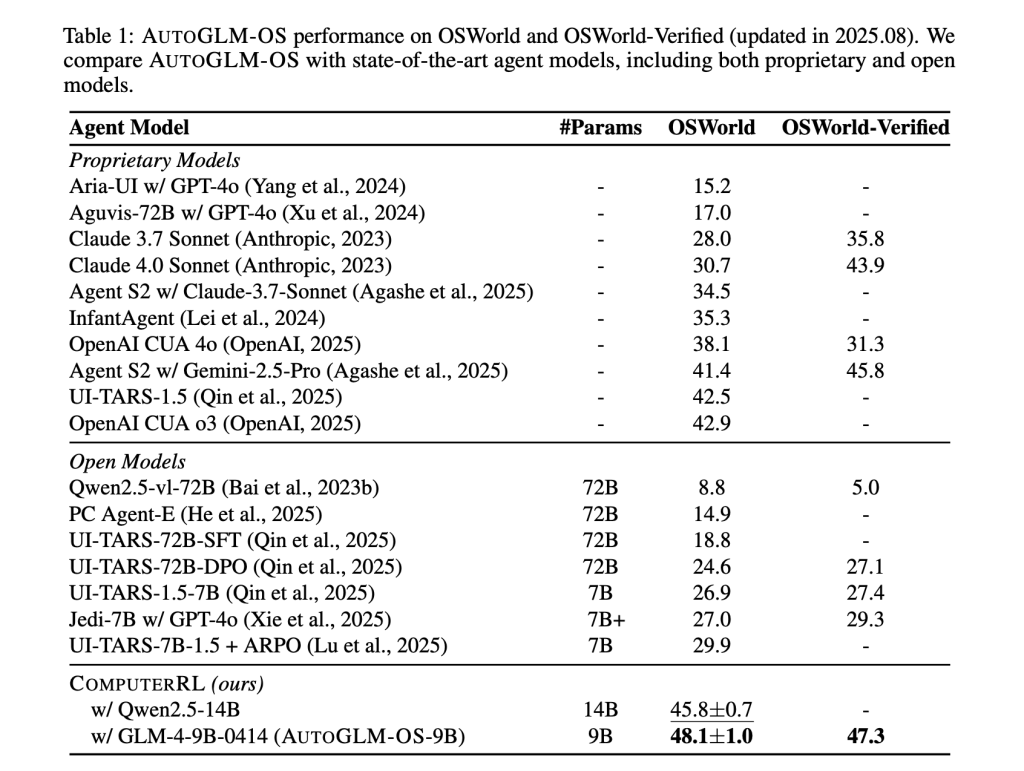
ComputerRL was applied to models such as GLM-4-9B-0414, Qwen2.5-14B and GLM-4-9B-0414. This resulted in AutoGLM OS variants. AutoGLM-9B scored 48.1% on the OSWorld benchmark which tests agents in Ubuntu interactive environments. This is higher than proprietary models such as OpenAI CUA o3 (42.9%) and Claude 4.0 (30.7%). Also, it scored 47.3% on OSWorld Verified.
Strengths of the framework are highlighted in ablation studies. API-GUI has improved success rates over GUI baselines by 134%, especially in the office and professional domains. Entropulse enabled exploration resulted in a 45.8% increase over the BC baseline. Entropy peaks confirmed Entropulse’s contribution to learning.
The case studies show the practicality of such features as creating tables for sales summaries in LibreOffice Calc, or using Terminal commands to generate system reports. Error analysis showed that there were still challenges, such as multi-app coordinaton (34.4%) and visual perception problems (25.8%).
Future Trends of Desktop Autonomy
ComputerRL is paving the way to more powerful agents, capable of coping with dynamic environments and long term tasks. Some of the potential advancements are expanding diversity in training, integrating perception across multiple modes, and creating hierarchical plans. For real-world deployments, safety features such as permission frameworks and actions validation are crucial. They will ensure aligned automation.
ComputerRL is a significant advancement for AI agents. It combines scalable RL and innovative interaction paradigms in order to revolutionize desktop intelligence. This framework is a great way to create general purpose agents that are more powerful and capable.
Take a look at the Technical paper here. Please feel free to browse our GitHub Page for Tutorials, Codes and Notebooks. Also, feel free to follow us on Twitter Join our Facebook group! 100k+ ML SubReddit Subscribe now our Newsletter.

Asif Razzaq serves as the CEO at Marktechpost Media Inc. As an entrepreneur, Asif has a passion for harnessing Artificial Intelligence’s potential to benefit society. Marktechpost was his most recent venture. This platform, which specializes in covering machine learning and deep-learning news, is both technically solid and understandable to a broad audience. This platform has over 2,000,000 monthly views which shows its popularity.
