


Many digital systems now include personalized recommendations, which aim to present content, services, and products that are aligned with the user’s preferences. It uses patterns, past behaviors, and interactions to make predictions about what users will find interesting. As time has passed, the techniques used have evolved from simple filtering models to more advanced ones powered by language comprehension. This allows systems to not only provide more accurate recommendations, but ones that also adapt to the users’ changing interests.
Understanding the dynamic and subtle preferences of users is key to making good recommendations. When user histories are sparse, or when users adopt new behaviors that diverge from their previous behavior patterns, many systems will fail. The simple similarity retrieval method or the methods that rely on recent events are not able to model long-term interest or changes in context. Lacking semantic reasoning, systems struggle to deliver relevant results when users’ demands change. It leads to a poor user experience where content is disconnected from the current search.

Recency-based rankings, for example, are widely used to select items according to how recent a user’s interaction with the item was. Other approaches use Retrieval Enhanced Generation (RAG( ), that selects items based on semantic embedding similarities between user data and metadata. This framework uses embedded-based recall, but it does not include deep reasoning and cross-session understanding. These systems may retrieve technical items but they fail to accurately filter and rank the results in order to capture user intent. This is especially true in domains like clothing or electronic devices, where context plays a crucial role.
Researchers from Walmart Global Tech have proposed ARAG (Agenttic Retrieval – Augmented Generation), a multi-agent solution. ARAG was introduced as a collaborative system of agents with a structured structure, designed for each agent to be responsible for a particular part of the process of recommendation. The agents are a User-understanding Agent, which profiles user behavior; a Natural Language Inference Agent, which scores item alignment to preferences; a Context Summary Agent, for condensing relevant content and an Item-Ranker Agent, that completes the ranked lists. The reasoning of each agent is specific to their task. This allows the recommendations to be more in line with session and historical context.
ARAG begins by retrieving all candidate items in a space using cosine-similarity. NLI agent evaluates the alignment of textual metadata with user intention. Context Summary Agent then compiles important information and ranks items based on alignment. Items that score higher are sent to this agent. In parallel, the User Understanding Agent produces a summary that is based on recent and past user behavior. The Item Ranker uses these summaries to rank and order items in the most likely order. All of this happens in shared memory. Agents can then reason together based on their findings. The setup allows for parallel processing to ensure that all user context and intent are incorporated into the final product.
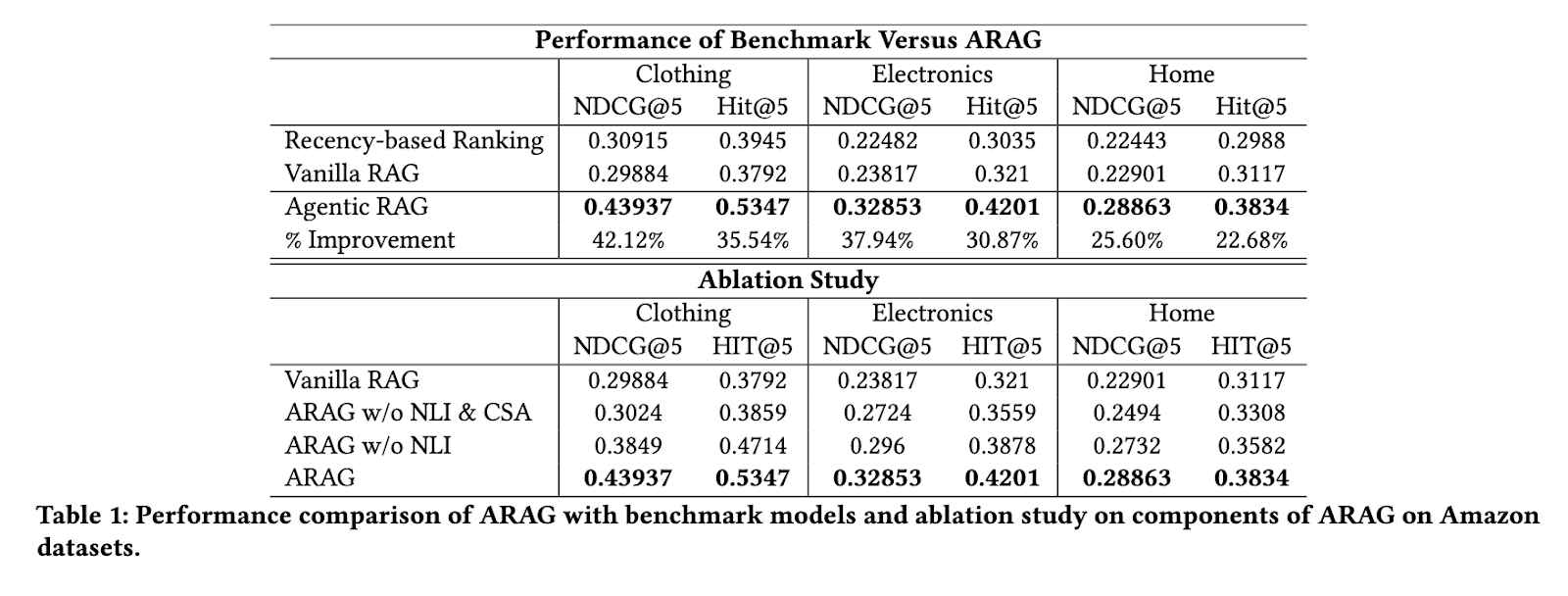
ARAG demonstrated consistent, strong improvement when it was tested against the Amazon Review dataset. Categories such as Electronics, Clothing and Home were included. ARAG improved NDCG@5 by 42.12% and Hit@5 by 35.54% compared with recency-based methods in the clothing category. Electronics saw a 42.12% increase in NDCG@5 and a 35.54% improvement in Hit@5 compared to recency-based methods. Also, the category of home saw significant improvement. NDCG@5 was up by 25.60% and Hit@5 was up by 22.68%. ARAG has a good track record of placing relevant items at the top. A study of ablation confirmed the importance of each agent. Removing NLI and context summary agents resulted lower accuracy.

They addressed a problem that is common in many recommendation systems: an inability to grasp the context of users. The researchers’ solution is based on collaboration among specialized agents and shows improvements in accuracy, relevance, and efficiency. This method shows how reasoning-based frameworks can be used to reshape recommendations systems in order to serve the user’s intent and context.
Click here to find out more Paper. The researchers are the sole credit holders for this work.
Sponsorship Opportunity: Would you like to contact the influential AI developers from the US or Europe? Join the 500K+ community of readers who read our blog every month and 1M+ subscribers. [Explore Sponsorship]

Nikhil works as an intern at Marktechpost. He has a dual integrated degree in Materials from the Indian Institute of Technology Kharagpur. Nikhil has a passion for AI/ML and is continually researching its applications to fields such as biomaterials, biomedical sciences and more. He has a background in Material Science and is always exploring advancements.
