


It’s a difficult task to understand what is happening during an audio clip. The easy part is to transcribing the spoken words. A truly capable system also needs to recognize who is speaking, detect their emotional state, interpret background sounds, analyze musical content, and answer time-grounded questions like ‘what did the speaker say at the 2-minute mark?’. All of this required multiple systems to be stitched together.
OpenMOSS, MOSI.AI, and Shanghai Innovation Institute release MOSS-AudioOpen-source model for audio comprehension designed to combine all those features into one foundation model.
What does MOSS Audio actually do?
MOSS-Audio supports Audio captioning is an example of complex reasoning. Over real-world audio. This capability set is broken down into distinct categories. Speech & Content Understanding This software recognizes, transcribes, and aligns the timestamps of spoken words and sentences. Speaker, Emotion & Event Analysis The software identifies the speaker, analyses emotional states using tone, timbre and context and detects important acoustic event within audio. Scene & Sound Cue Extraction The system uses background noises, non-speech signals, and environmental sounds to derive scene context and ambience. Musical Understanding Analyzes the musical style, emotion progression and instruments. Audio Question Answering & Summarization Answers questions, including summaries, in speech, podcasts and meetings. Finally, The Complexity of Reasoning The multi-hop reasoning software is powered by chain-of thought training as well as reinforcement learning.
A single MOSS Audio model is capable of all the above, without having to switch between multiple specialized systems.
Four Model Variants
At launch, the team launched four different variants: MOSS-Audio-4B-Instruct, MOSS-Audio-4B-Thinking, MOSS-Audio-8B-InstructThen, MOSS-Audio-8B-Thinking. It’s important to understand the naming convention when deciding on which one to use. It is important to understand the naming convention when deciding which one you want to use. Instruct The variants have been optimized to follow direct instructions, which makes them ideal for pipelines that require predictable and structured outputs. The outputs of the pipeline are structured and predictable. Consideration The variants have stronger reasoning abilities, making them better-suited to tasks that require multiple-hop inference. The 4B model uses Qwen3-4B As the LLM and 8B models. Qwen3-8BThe total size of the model is approximately 4.6B and 8B respectively.
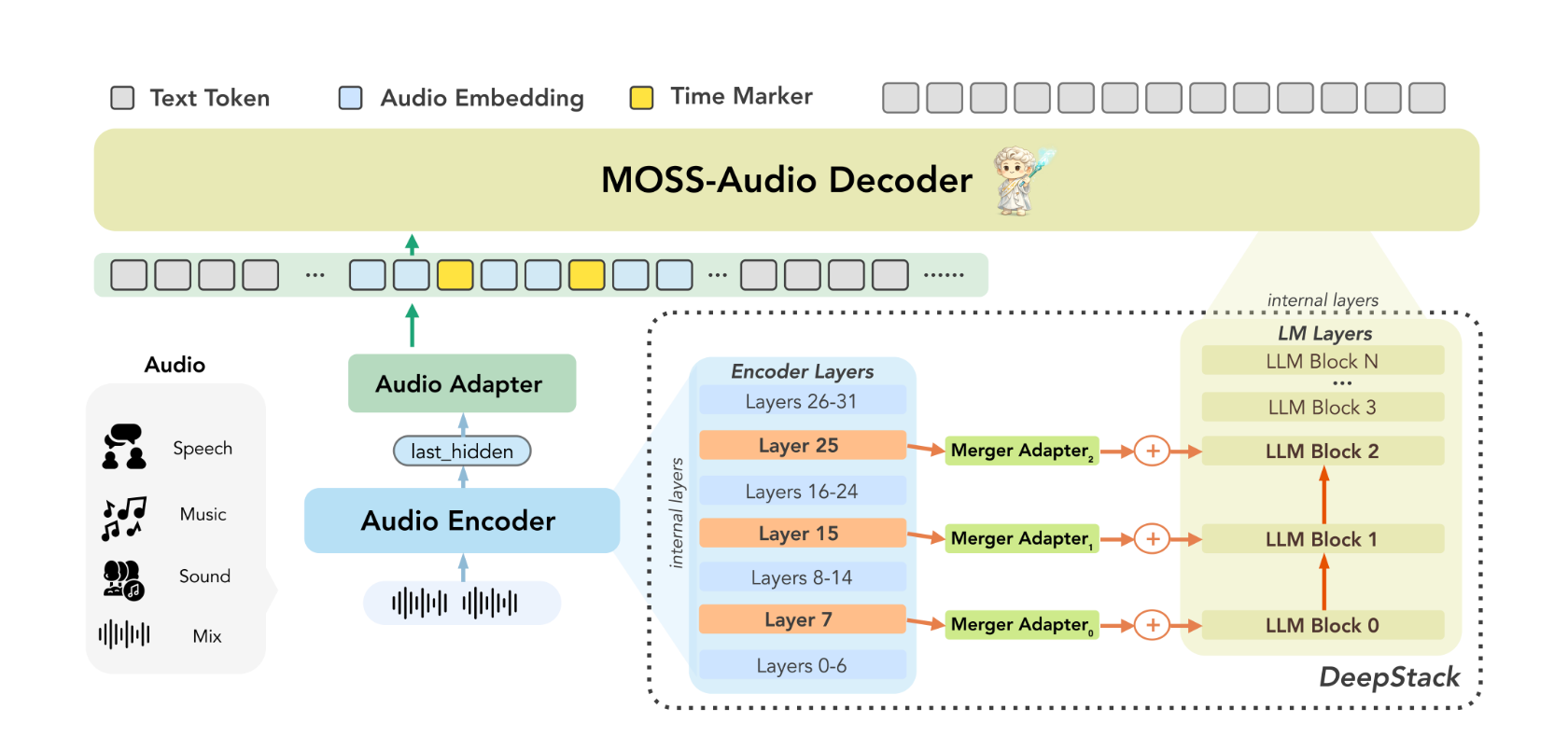
Three components of the Architecture working together
MOSS-Audio follows a Three components make up the modular design: an audio encoder (audio encoder), a modality-adapter (modality adapter), and a large languages model.. The encoder first converts the raw audio. MOSS-Audio-Encoder Continual temporal representations 12 Hz. These representations are projected in the embedding area of the language model through the adapter and then consumed by the LLM to generate auto-regressive texts.
Instead of using off-the shelf audio frontends, the research team created its own encoder. They argued that an encoder dedicated to speech would provide more accurate representations and tighter timing, as well as greater flexibility across different acoustic fields.
MOSS Audio has two unique architectural features that are well worth examining in depth.
DeepStack Cross-Layer Feature InjectionMOSS-Audio addresses this with a new feature that allows you to use the top layer features of an encoder without losing low-level information. This includes things such as prosody, transients, and time-frequency structures. This problem is tackled by MOSS Audio with an DeepStackThis module allows for cross-layer integration between the encoder (the final output) and the language models. Features from intermediate and previous layers are also selected and independently projected into the first layers of the language model. It preserves information at multiple levels, from acoustic to semantic, while retaining rhythm, timbre and background structure.
The Time-Aware RepresentationMOSS-Audio addresses this through a time dimension that is critical in audio. Text models can’t handle it naturally. This is addressed by MOSS-Audio through an Time-marker Insertion Pretraining strategy: time markers are placed between audio frames at predetermined intervals in order to show temporal position. This lets the model learn ‘what happened when’ within a unified text generation framework, naturally supporting timestamp ASR, event localization, time-based QA, and long-audio retrospection — without requiring a separate localization head or post-processing pipeline.
Benchmark Performance
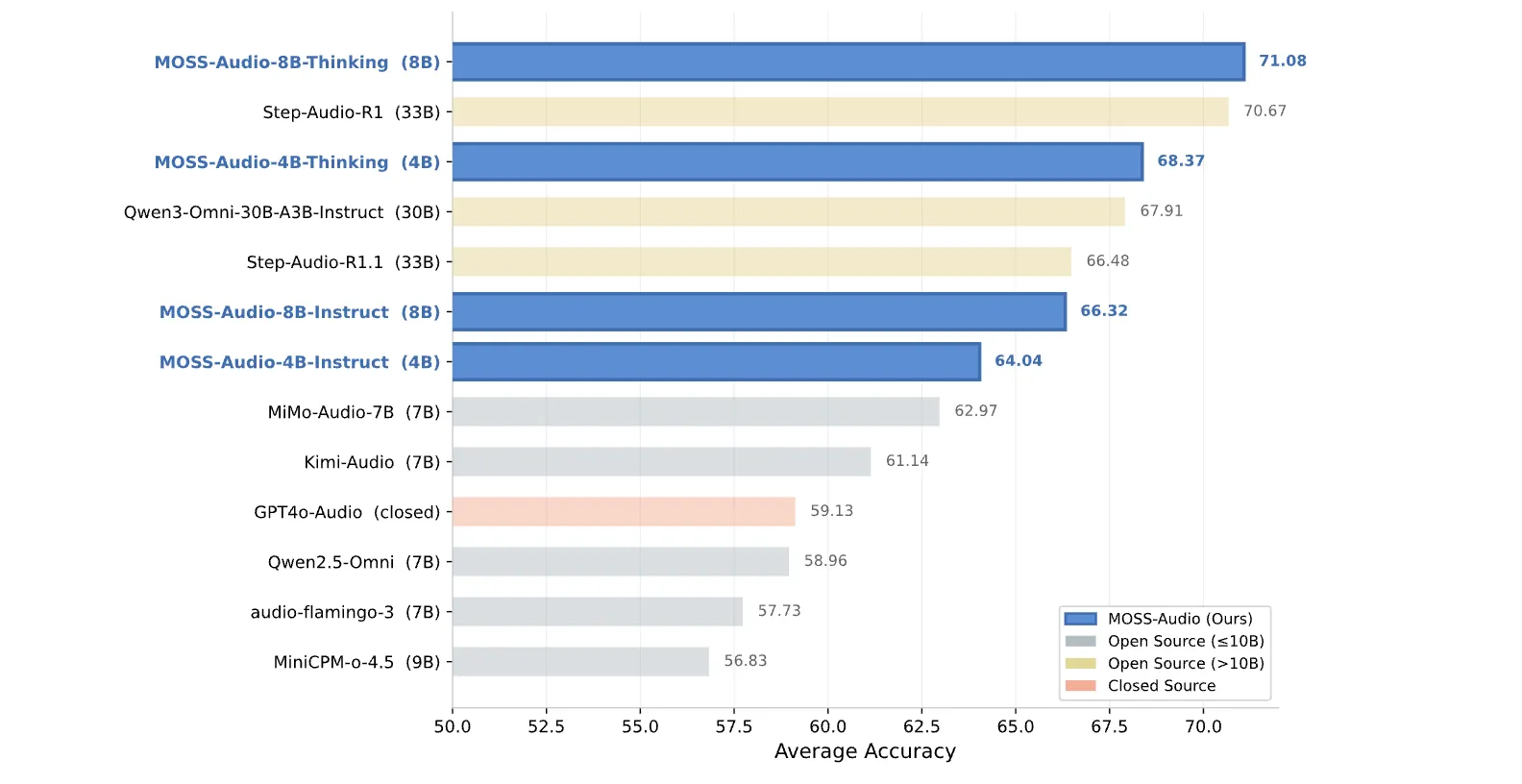
The numbers speak for themselves. On general audio understanding, MOSS-Audio-8B-Thinking achieves an average accuracy of 71.08 across four benchmarks — 77.33 MMAU, 64.92 on MMAU Pro, MMARThen, 75.52 on MMSUThe majority of models are open-source. That includes larger models: Step-Audio-R1 at 33B scores 70.67, and Qwen3-Omni-30B-A3B-Instruct at 30B scores 67.91. As a comparison, Kimi-Audio 7B is rated 61.14 while MiMo Audio-7B receives 62.97. 4B Thinking scores 68.37. This means that the model’s chain-of thought training is superior to all other open-source competitors.
The following are some of the ways to get in touch with us. Speech captioning, evaluated with an LLM-as-a-Judge methodology across 13 fine-grained dimensions including gender, age, accent, pitch, volume, speed, texture, clarity, fluency, emotion, tone, personality, and summary, MOSS-Audio-Instruct variants lead across 11 out of 13 dimensions, with MOSS-Audio-8B-Instruct achieving the best overall average score of 3.7252.
The following are some of the ways to get in touch with us. Automatic speech recognition (ASR). spanning 12 evaluation dimensions — including health condition, code-switching, dialect, singing, and non-speech scenarios — MOSS-Audio-8B-Instruct achieves the CER (Character-Error Rate) is at its lowest level of 11,30 All tested models.
What you need to know
- All Audio Models in Single ModelMOSS Audio unifies all speech transcription functions, including speaker and emotion analyses, environmental sound understanding and music analysis. It also includes time-aware Quality Assurance (QA) and complex reasoning.
- The Performance of Two Architecture InnovationsDeepStack Cross Layer Feature Injection maintains multi-granularity of acoustic data by injecting feature from the intermediate encoder layer directly into LLM’s initial layers. Time-marker insert during pretraining provides explicit temporal awareness to the model for tasks based on timestamps.
- Benchmarking Results that are Best in Class at an Efficient Scale: MOSS-Audio-8B-Thinking achieves an average accuracy of 71.08 on general audio understanding benchmarks, outperforming all open-source models including 30B+ systems, while the 4B Thinking variant alone beats every larger open-source instruct-only competitor.
- Dominant timestamp ASR Accuracy: MOSS-Audio-8B-Instruct scores 35.77 AAS on AISHELL-1 The following are some examples of how to get started: 131.61 AAS on LibriSpeech, dramatically outperforming both Qwen3-Omni-30B-A3B-Instruct (833.66) and the closed-source Gemini-3.1-Pro (708.24) on the same benchmark.
Check out the Model Weights and Repo. Also, feel free to follow us on Twitter Join our Facebook group! 130k+ ML SubReddit Subscribe Now our Newsletter. Wait! What? now you can join us on telegram as well.
You can partner with us to promote your GitHub Repository OR Hugging Page OR New Product Launch OR Webinar, etc.? Connect with us
