


It is a habit of mine to view the creation of content as an individual sport.
I am used to posting my own thoughts in a blog format. It is a good idea to use a different language. I saw it It is a good idea to use a different language. Loved and want to recreate. If I am stuck for ideas, I look through my bookmarked posts. There are hundreds.
I’ve been fortunate that that system works time and time again for me — but it’s not the only way to create.
After a few months, I decided to try something new, which I think I need to be doing more of: I asked people in my community.
Do not be vague. “what should I post about?” way — but with a specific, open-ended question. And what followed was a flood of thoughtful, deeply relatable replies — the kind that made me realize that the best content ideas aren’t buried in your own brain. Your comment section is where they’re hidden.
In this post, I’ll share how I ran this mini experiment, the types of responses it sparked, and how I turned those replies into content that resonated — a self-sustaining flywheel. I’ll also break down how you can try it — whether you’re running a brand account, building your personal presence, or just feeling stuck on what to post next.
I framed the whole thing as a lightweight experiment — one post, one question, one goal: to see what would happen if I handed the mic over to my audience.
In many ways, it functioned like a mini AMA — an open door to ask anything without the pressure of needing the “perfect” question. It went further than that. This wasn’t just a Q&A — it became a content loop. My content strategy became rooted in a dialogue between me and my audience. The posts turned into questions, which then led to more conversations.
The attempt was a sincere one: the comments section should be treated as if it were the first discovery of the post, and not its aftermath.
What I’ve posted
“What’s a challenge, moment, or question you’ve faced related to personal branding or career growth that you’d love to see me unpack in a post?”
This post’s success is largely due to the fact that I did not try and lure people in by presenting them with easy-to-read content. It worked.
I heard from freelancers, strategists, job seekers, creators, and community managers — each with their own angle on what they were navigating. Others asked for help in simplifying the explanation of what they do. Some asked for help balancing their personal brand with that of the company, while others wanted to know how to determine when to change your focus.
Each response has sparked new ideas.
That was the moment it clicked: When you ask a question rooted in your content pillars, you don’t just get random replies — you get ready-made posts, straight from the people you’re trying to reach.
They covered more material than I thought. It turned out that even though I wanted to post several more questions, the content I already have is enough for me to cover several weeks.
There are some questions that can be considered tactical.
- “How do I stay consistent with posting while working full-time?”
- “What should I tweak when my freelance pitches go quiet?”
- “How do I talk about my brand strategy work when it’s not visual?”
Some people were more personable:
- “When do you know you’re ‘experienced enough’ to teach?”
- “How do you balance representing your company and being fully yourself?”
- “What’s the best way to explain what you do without rambling?”
Nothing felt too out there for me to answer — even the question about which came first? Which came first, the chicken or egg? By the way, I always choose chicken.
It reminded me that your audience’s questions are rarely brand new — but they’re new challenges to them. They’re also new to your point of view. No need to prepare an answer. Listen, and then tell what you have learned so far.
In many ways, the responses allowed me to write about things I might’ve otherwise skipped — not because they weren’t important, but because I thought they were too obvious. It turns out. “obvious” Often, people are looking for exactly the right thing.
What I did to turn my responses into posts
The real magic of this experiment wasn’t just in the replies — it was in what came next.
Each comment ignited a flame. Some comments turned into complete reflections. Other ideas became an outline or a jumping off point for a conversation I was planning anyway. Best part? The best part? I already knew they struck a chord — because someone asked for them.
How a few comments became actual posts
- It is not a good idea to use the word “no” in a sentence. “How do you explain what you do without rambling?”→ Post: Here is my pitch in one sentence and the template I used.
- It is not a good idea to use the word “no” in a sentence. “How do you balance your personal brand when you also work at a company?”→ Post: Reflections on building a personal brand, boundaries and representation Consider Buying This Product Work, but not only because You can’t.
Every post gave credit to the person or people who had asked. It created a positive feedback loop: Someone felt appreciated, I was able to create something of value, and other users added even more.
This format is collaborative, and that’s why it works. It helps me write posts that don’t just reflect my own thinking — they reflect what people actually want to explore through my experience. This encourages them to participate.
This doesn’t require a large audience or viral posts. Just a willing ear and an understanding of the theme are all you need.
You can easily crowdsource ideas for content from within your community.
- Choose a date and themeSelect one of your favorites content pillars — personal branding, remote work, freelancing, etc. — and set aside a day to post an open-ended question about it. Do not over-explain. Just show you are listening. It could be in the form of a focused AMA.”Ask me anything about pivoting your brand” You can also find out more about “What’s one thing you wish you knew before going freelance?”Make it casual, but still targeted.
- Ask a question about your community, not yourself: You can also use “what should I write about?” You can try this: “What’s a challenge you’re currently facing around [topic] that you’d love to see unpacked in a post?” The goal is to get people to share what they actually care about — not just echo what they think sounds smart.
- Comment on the postAsk clarifying questions, and give a response. Interacting more often will improve the responses. You can still get the best results even without having to have the software. “perfect” Your answer is valuable. Tell us what has worked well for you. Share your observations or things you are still trying to figure out. It’s often better to be honest than give a list of tips.
- Find emotional overlap: If multiple people are circling the same challenge — or if one comment makes you feel something — that’s your cue. Repeated mentions and resonance indicate that the topic is worth writing.
- Transform your replies into original content.Even if they didn’t say it exactly, acknowledge them by giving a little nod. You’ll build trust and create a stronger connection.
- Answering all questions at once is not possible.Some questions require more than one post. Zoom in. Focus on one layer of the topic — the mindset shift, the first step, the personal story. It’s always possible to revisit it from a new angle later.
Save comments even if they don’t become content right away. In Buffer I have a list of post and question ideas, organized by format and pillar, to ensure I’m always prepared when I run out of inspiration.
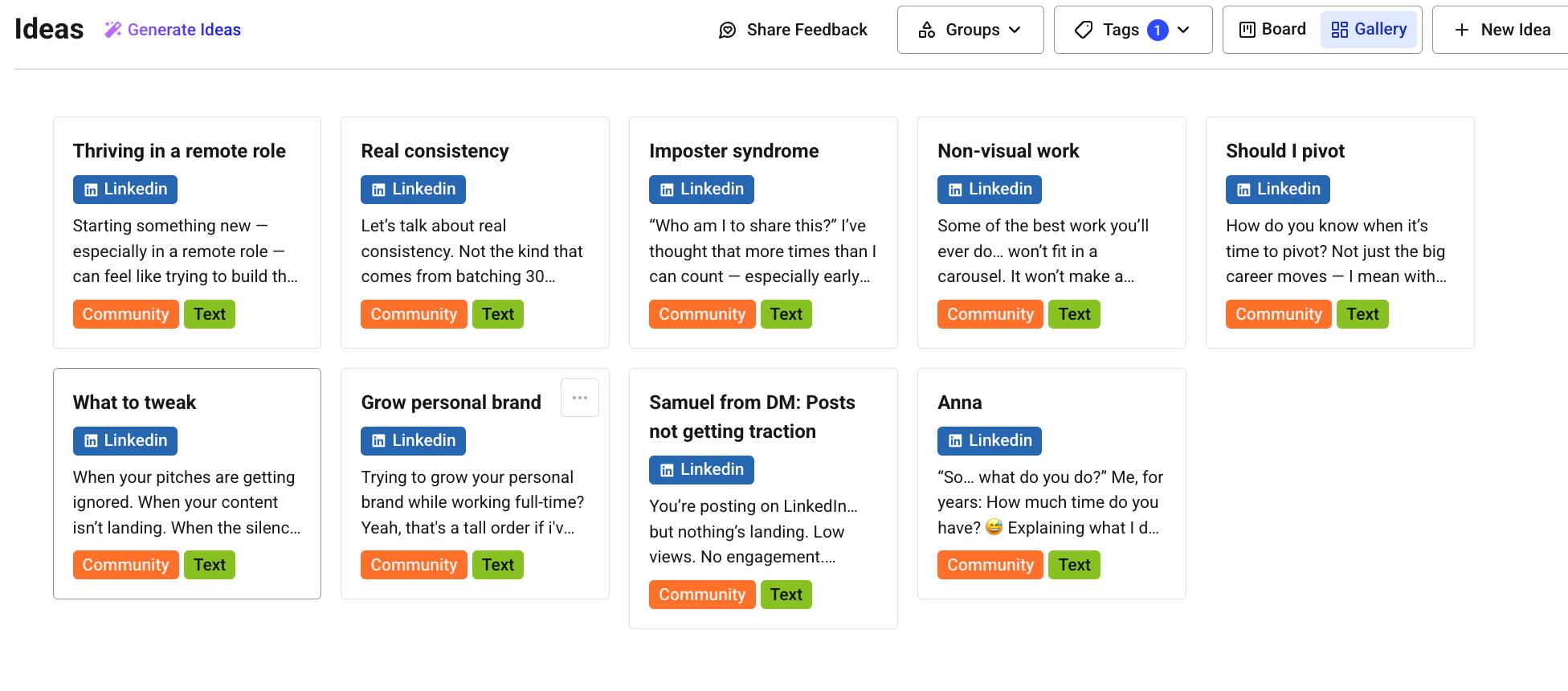
This experiment worked well because it started with a clear question and a willing community — but it’s not the only way to find ideas rooted in what your audience cares about.
Here are some other ways you can find content through conversations in your community.
- Reddit, Quora and other public forums are great places to start.They are a goldmine for genuine, unfiltered queries. Search for your niche or keywords related to your expertise and look for threads with lots of comments or upvotes — they usually reflect a shared pain point.
💡
Pro tipCopying the answers of others is not a good idea. Consider what they disagree about or the areas where there is confusion. This is your first step.
- You can check in with the customer facing team members: If you work on a team, your sales, support, and community folks are sitting on insights you can turn into content — FAQs, common frustrations, moments of delight. A quick Slack message like “What’s one thing our users always ask about?” A great blog post can be sparked by a good article.
- You can use SEO to improve your website. social listening toolsSemrush and AnswerThePublic are two tools that can be used to spot popular questions or topics. You’re not chasing keywords here — you’re looking for phrasing and patterns that match real user curiosity.
- Watch replies and DMs: Some of the best insights aren’t in public comments — they’re in quiet replies, email feedback, or DMs. Search for lines beginning with: “This really resonated” You can also find out more about “I’ve been wondering about this too.” These aren’t just compliments but also signals for ideas.
You audience has your next great idea
The whole thing started out as an attempt to break free from a rut. I was looking for new ideas. The only thing I received was a gentle reminder that content creation does not have to be done alone.
The people who follow your work often have the exact questions you’re equipped to answer — you just have to invite them into the process.
After trying this method, I now think of content as more of a conversation than a broadcast. The first line of the post. Comments are second. Your response will be what you make next.
It’s not about handing over your content strategy — it’s about expanding the room where ideas happen.
Try this next time when you’re stuck:
- Ask one clear, generous question.
- Have your audience respond to you in their words.
- Write the post The following are some of the most effective ways to improve your business. needed — and probably a few others will too.
Try it yourself — post your own community-sourced question this week and tag us @buffer if you do. Your audience’s ideas are always welcome.
