


Google Research introduces in-context fine-tuning (ICF) for time-series forecasting named as ‘TimesFM-ICF): a continued-pretraining recipe that teaches TimesFM to exploit multiple related series provided directly in the prompt at inference time. The forecast is then a short-term few-shot. Matches supervised fine tuning while delivering +6.8% accuracy over the base TimesFM across an OOD benchmark—no per-dataset training loop required.
Which pain points in forecasting are being eliminated?
Many production workflows trade-off between (a) supervised refinement of a single model for each dataset (accuracy with heavy MLOps), and (b) foundation models that are simple but do not adapt to the domain. Google’s latest approach retains a pre-trained TimesFM but allows it to be adapted. You can adapt to the situation on-the-fly Inferences can be made by using only a small number of examples in context from similar series, and avoiding pipelines for each tenant.
What is the in-context tuning process?
Get started TimesFM—a patched, decoder-only transformer that tokenizes 32-point input patches and de-tokenizes 128-point outputs via a shared MLP—and continue pre-training Sequences in which the history of the target is interspersed with other sequences “support” series. Now, the main change is introduced. Learnable Common Separator TokenThe training objective remains next-token prediction; what’s new is the cross example causal attention. It’s still the same training objective: next-token predictions. What is new, however, is the Contextual construction The model is taught to make inferences across several related series.
What is “few-shot” here?
The user then concatenates kk more time series snippets with the target’s history (e.g. similar SKUs and adjacent sensors), with each segment being separated by a separator token. The model’s attention layers are now explicitly trained to leverage those in-context examples, analogous to LLM few-shot prompting—but for numeric sequences rather than text tokens. The adaptation is now shifted from parameter updates into Rapid engineering over structured series.
Do you have a supervised tuning?
A 23 dataset suite of out-of domain data, TimesFM-ICF The performance is the same as per-dataset TimesFM-FT When being TimesFM Base is 6.8% more accurate. Geometric Mean of Scaled MASE It also displays the expected accuracy–latency trade-offMore examples in context yields better forecasts, but at the expense of longer inference. A “just make the context longer” Ablation shows that examples with a structured context beats long, naive context alone.
What makes this approach different than Chronos?
Chronos Tokenizes values and demonstrates strong leadership. zero-shot Accuracy and fast variants, e.g. Chronos Bolt. Google isn’t just adding another tokenizer, or increasing the headroom for zero-shot. It’s actually making an a The FM time series behaves like an LLM limited-shot student—learning from cross-series context at inference. This capability bridges the gap in between “train-time adaptation” You can also find out more about the following: “prompt-time adaptation” Numeric Forecasting
What architectural details should I be aware of?
Researchers highlight: Separator tokens To mark boundary lines, (2) Cause-and-effect attention Over mixed histories and example, (3) persisted Patching Shared MLP heads and continued pre-training are all ways to encourage cross-example behaviors. Together, they allow the model to be able to treat support as a series. informative exemplars Background noise is preferable to other types of sound.
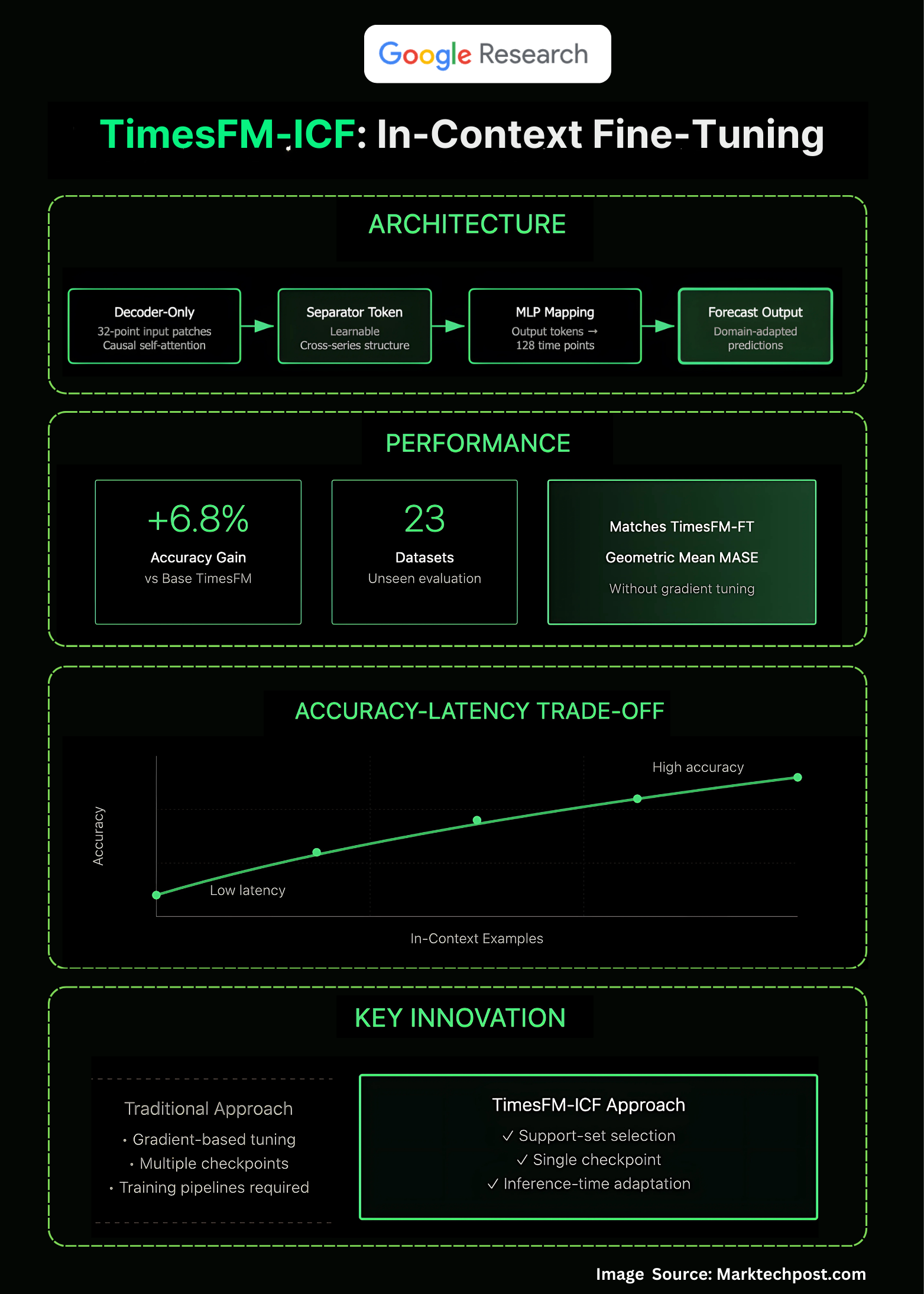
The following is a summary of the information that you will find on this website:
Google’s in-context fine-tuning turns TimesFM into a practical few-shot forecaster: a single pretrained checkpoint that adapts at inference via curated support series, delivering fine-tuning-level accuracy without per-dataset training overhead—useful for multi-tenant, latency-bounded deployments where selection of support sets becomes the main control surface
FAQs
Google: What are the main features? “in-context fine-tuning” ICF time series:
ICF continues pre-training to condition TimesFM for multiple series related placement in the prompt Inference allows for few-shot adaption without having to update gradients on each dataset.
What is the difference between ICF and standard fine-tuning or zero-shot usage?
The standard fine-tuning update weights for each dataset. Zero-shot only uses the history of the target. ICF maintains weights as they are at deployment. However, it learns more during pre-training. What is the best way to learn about? Use extra examples in context, to match per-dataset fine tuning on reported benchmarks.
What changes in architecture or education were made?
TimesFM has been pre-trained to continue with a sequence that interleaves target history, and the support series. This is separated by boundary tokens in order for causal attention to exploit the cross-series.
What are the differences between baselines and results?
ICF is superior to TimesFM and can be compared with fine-tuning.
Click here to find out more Paper You can also find out more about the following: Technical details. Please feel free to browse our GitHub Page for Tutorials, Codes and Notebooks. Also, feel free to follow us on Twitter Join our Facebook group! 100k+ ML SubReddit Subscribe now our Newsletter.
For content partnership/promotions on marktechpost.com, please TALK to us

Asif Razzaq, CEO of Marktechpost Media Inc. is a visionary engineer and entrepreneur who is dedicated to harnessing Artificial Intelligence’s potential for the social good. Marktechpost is his latest venture, a media platform that focuses on Artificial Intelligence. It is known for providing in-depth news coverage about machine learning, deep learning, and other topics. The content is technically accurate and easy to understand by an audience of all backgrounds. This platform has over 2,000,000 monthly views which shows its popularity.
