


Open vocabulary object detectors respond to text queries by using boxes. Zero shot performance in remote sensing drops due to classes being fine-grained, and the visual context not common. Google Research proposes FLAMEThe refiner can be trained in real-time on the CPU. It generates proposals with high recall, while the refiner eliminates false positives by using targeted labels. It provides reports. State of the Art Precision on DOTA You can also find out more about the following: DIOR The following are some examples of how to use The 30 Shots” minute scale adaptation per label on a CPU.

Problem framing
OWL ViT and similar open-vocabulary detectors, such as OWL v2, are trained by using pairs of web scale images. Although they generalize very well with natural images, their performance is less than optimal when dealing with categories that are more subtle. For example, chimneys versus storage tanks, or when imaging geometry differs, such as nadir tiles and rotated objects, the accuracy of these detectors can be affected. For categories that look similar, the embedding of the text and visual elements overlap. This leads to a loss in precision. It is not possible to have a practical system that has the open vocabulary of the world and the precision of the local specialist without spending hours on GPU fine tuning.
In concise, the method and design
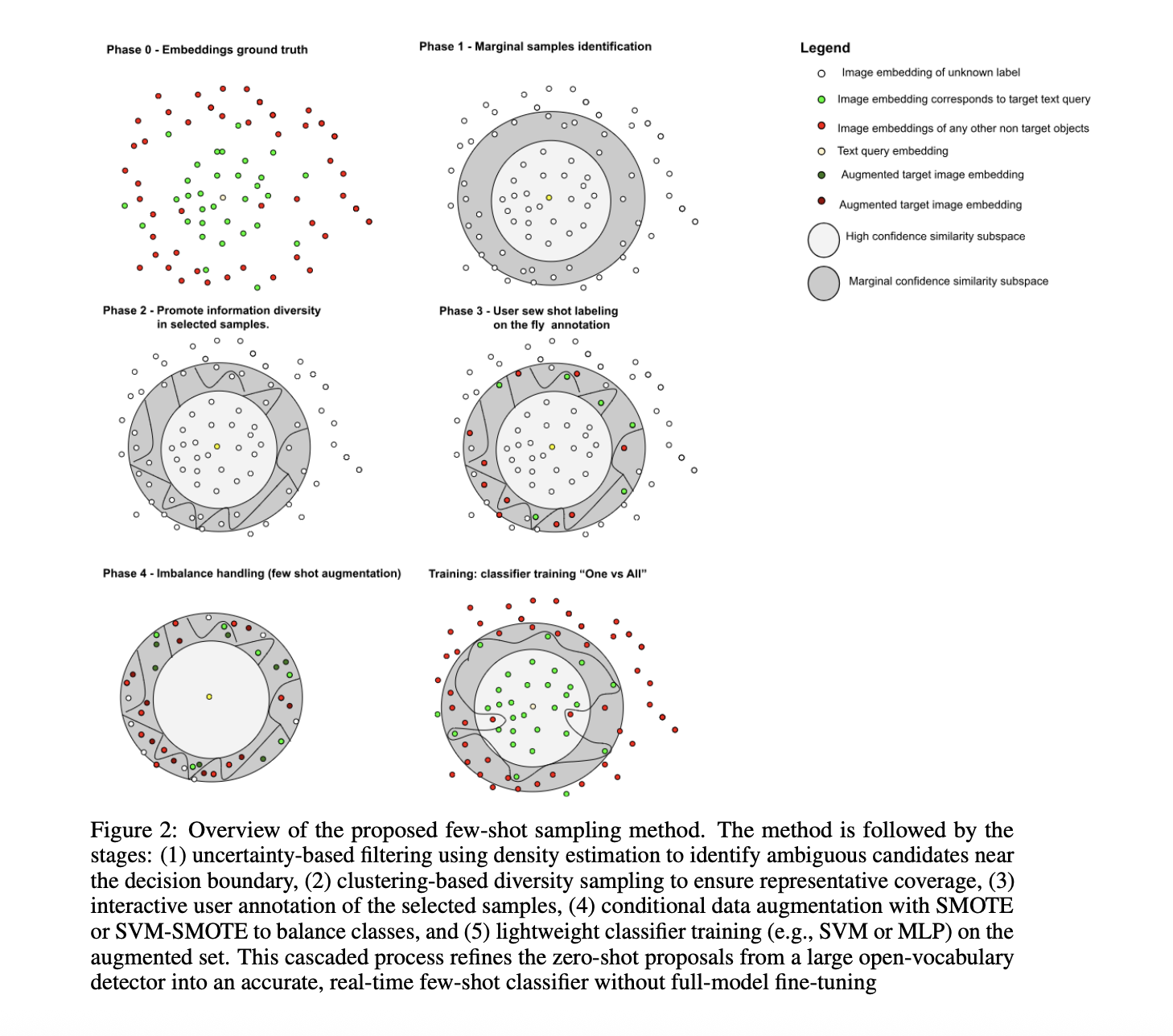
A FLAME is the a Cascade pipeline. First, use a zero-shot open vocabulary detector. This will produce many boxes that are candidates for text queries. “chimney.” Then, step two: represent the candidates with their visual characteristics and similarity of text. The third step is to create a textual representation of each candidate. Retrieve marginal samples Select the band that is closest to the boundary of the decision. Do a PCA low-dimensional projection, followed by a densitometer estimate. Fourth step cluster Pick one item from each cluster. Five, create a label for the user. 30 Positive or negative crops? Sixth step Rebalance your balance at any time If the labels are misaligned, you can use SVM or SMOTE. The seventh step is to align the labels. A small classifier can be used to trainThe original proposal can be accepted or rejected using, for instance, an RBF SVM, or two-layer MLP. Base detectors remain frozen so that you can continue to recall and generalize, while the refiner begins to learn the precise semantics of the user.
The datasets are the base models and the setup.
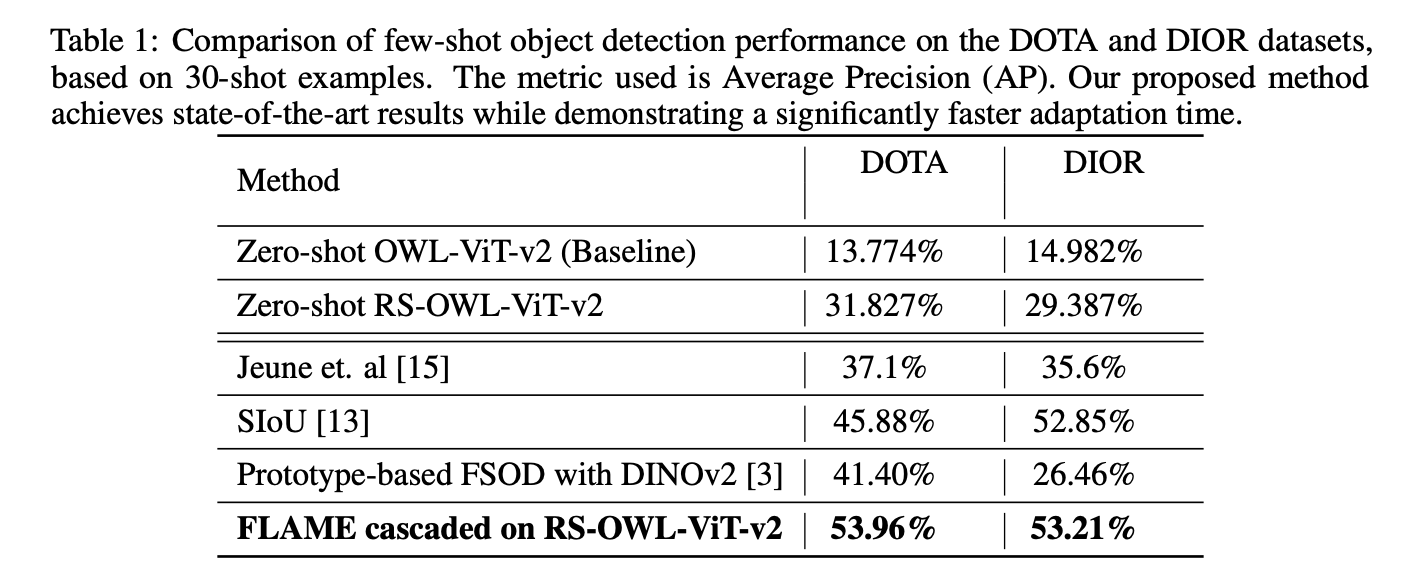
Evaluation uses two standard remote sensing detection benchmarks. DOTA There are 15 categories of aerial photographs in high resolution. DIOR The comparison includes a total of 192,472 images in 20 categories. Comparison includes: zero shot OWL ViT v2 baselineA zero shot RS OWL ViT v2 This is what you need to fine tune on RS WebLIThere are several baselines that have zero shots. RS OWL ViT v2 improves zero shot mean AP to 3.1827 percent DOTA 29.387 per cent FLAME is based on DIOR.
Understanding Results
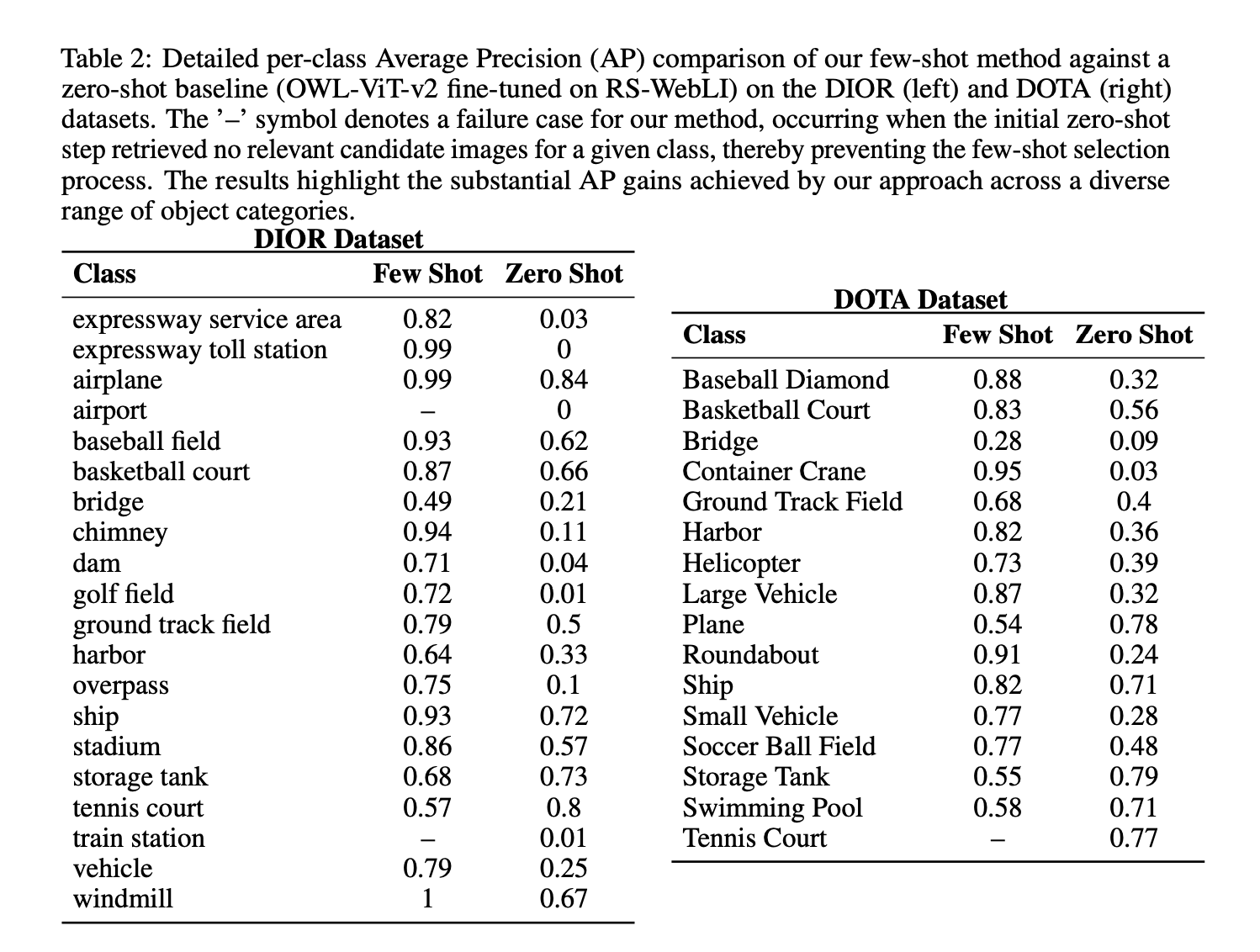
You can find out more about this by clicking here. The 30 Shot adaptation, FLAME cascaded over RS OWL ViT v2 The reaches 53.96 percent AP On, DOTA You can also find out more about the following: 53.21% AP On, DIORThe comparison includes SIoU, a prototype-based method with DINOv2, and a few shot method proposed by the research team. Comparing SIoU to a prototype method with DINOv2 as well as a method developed by the team, and also a method based on a few shots. The numbers are shown in Table 1. The team reports on the breakdown of each class in Table 2,. On DIORThe мурну The class has improved from 0.11 in zero shot to 0.94 The refiner, FLAME (after), removes the false positives of the look-alikes in the open vocabulary.
The Key Takeaways
- This is FLAME, a cascade of active learning that is one step over OWL VIT v2. It uses density estimation to retrieve marginal samples, clusters them, gathers 30 labels and then trains a lightweight refiner, such as a RBF SVM, or small MLP.
- After 30 shots FLAME on RS OWLI ViT v2 reaches a 53.96% AP for DOTA, and a 53.21% AP for DIOR. This is higher than previous baselines, including SIoU, and compared to ‘prototype method DINOv2.
- After FLAME’s strong filtering, DIOR shows a chimney class improvement from 0,11 for a zero-shot to 0.94.
- The user can be specialized in near-real time on the standard CPU.
- RS OWL v2 boosts the zero shot AP up to 31,827% on DOTA, 29.387% on DIOR and FLAME adds precision on top.
It is a cascade of active learning that combines a small refiner with OWL ViT V2, selects marginal detectors, collects 30 labels and trains a classifier. This all happens without changing the base model. In DOTA and DIOR FLAME reports a 53.96 and 53.21 % AP respectively, establishing a solid few shots baseline. The average precision on DIOR’s chimney increases from 0.11 percent to 0.94 percent after refinement. This shows false-positive suppression. On a computer, adaptation runs at about 1 minute per tag. This allows for interactive specialization. OWLv2 & RS WebLI are the basis for zero-shot proposals. FLAME demonstrates a practical pathway to open vocabulary detector specialization by pairing RS ViT v2 proposal with a small scale CPU refiner. This raises DOTA up to a 53.96 percent AP, and DIOR is raised to a 53.21 percent AP.
Click here to find out more Paper here. Please feel free to browse our GitHub Page for Tutorials, Codes and Notebooks. Also, feel free to follow us on Twitter Join our Facebook group! 100k+ ML SubReddit Subscribe now our Newsletter. Wait! Are you using Telegram? now you can join us on telegram as well.

Asif Razzaq serves as the CEO at Marktechpost Media Inc. As an entrepreneur, Asif has a passion for harnessing Artificial Intelligence’s potential to benefit society. Marktechpost was his most recent venture. This platform, which specializes in covering machine learning and deep-learning news, is both technically solid and understandable to a broad audience. Over 2 million views per month are a testament to the platform’s popularity.
