


Learning-Based Robotics
The use of data-driven algorithms to replace manual coding has made huge progress in the development of robotic control systems. Modern robots do not rely on programming but instead learn from observing and imitating actions. This type of learning is often based on behavioral cloning and allows robots to operate effectively in structured environments. Transferring these behaviors to dynamic real-life scenarios is a difficult task. Robots are not just required to perform the same actions, but must also be able to adjust and improve their response when faced with unfamiliar environments or tasks. This is crucial for achieving generalized behavior.
The Challenges of Traditional Behavioral Cloning
The dependence of robot policy learning on human demonstrations is one of its main limitations. They are then used for supervised-learning to generate initial policies. Additional demonstrations may be required to train them if these policies are unable to generalize in a new setting or do so accurately. This inefficiency is due to the inability of robots to adapt policies to their own experience. The use of reinforcement learning to improve autonomously is possible, but its inefficiency with samples and dependence on accessing complex policy models makes it inappropriate for most real-world applications.
There are limitations to the current diffusion-RL integration
To refine robot behavior, different methods have been tried. Some of these efforts focused on the modification of early stages in the diffusion process, or the application additive adjustments to the policy outputs. Some have attempted to maximize actions through evaluating the expected rewards in denoising. Although these approaches improved the results of simulations, they required extensive computations and direct access into policy parameters. They are not practical for models that use black boxes or proprietary algorithms. On top of that, these models struggle with instability caused by backpropagation through diffusion chains.
The DSRL Framework for Latent Noise Policy Optimization
Researchers at UC Berkeley (UCB), the University of Washington and Amazon developed a method called Diffusion Steering Via Reinforcement-Learning (DSRL). The adaptation is shifted from changing the weighting of the policies to optimizing latent noise in the diffusion models. DSRL does not generate actions using a Gaussian distribution but instead trains a second policy which selects input noise to steer the resulting action towards desired outcomes. It is possible to use reinforcement learning for fine-tuning behaviors, without having to alter the base model.
The Latent Noise Space and Decoupling of Policy
Researchers reconfigured the learning environment through mapping of the initial action space into a space with latent-noise. This transformed set-up allows actions to be selected by selecting the latent sound that produces them, through diffusion policies. DSRL uses only the forward-outputs of the policy to create a reinforcement learning system that is completely independent from the base policy. It is adaptable for real robotic systems that only have black-box accessibility. This policy can then be trained by using actor-critic techniques, saving the cost associated with backpropagation. It allows online learning via real-time interactivity and offline learning using pre-collected datasets.
The Empirical Benefits and the Practical Results
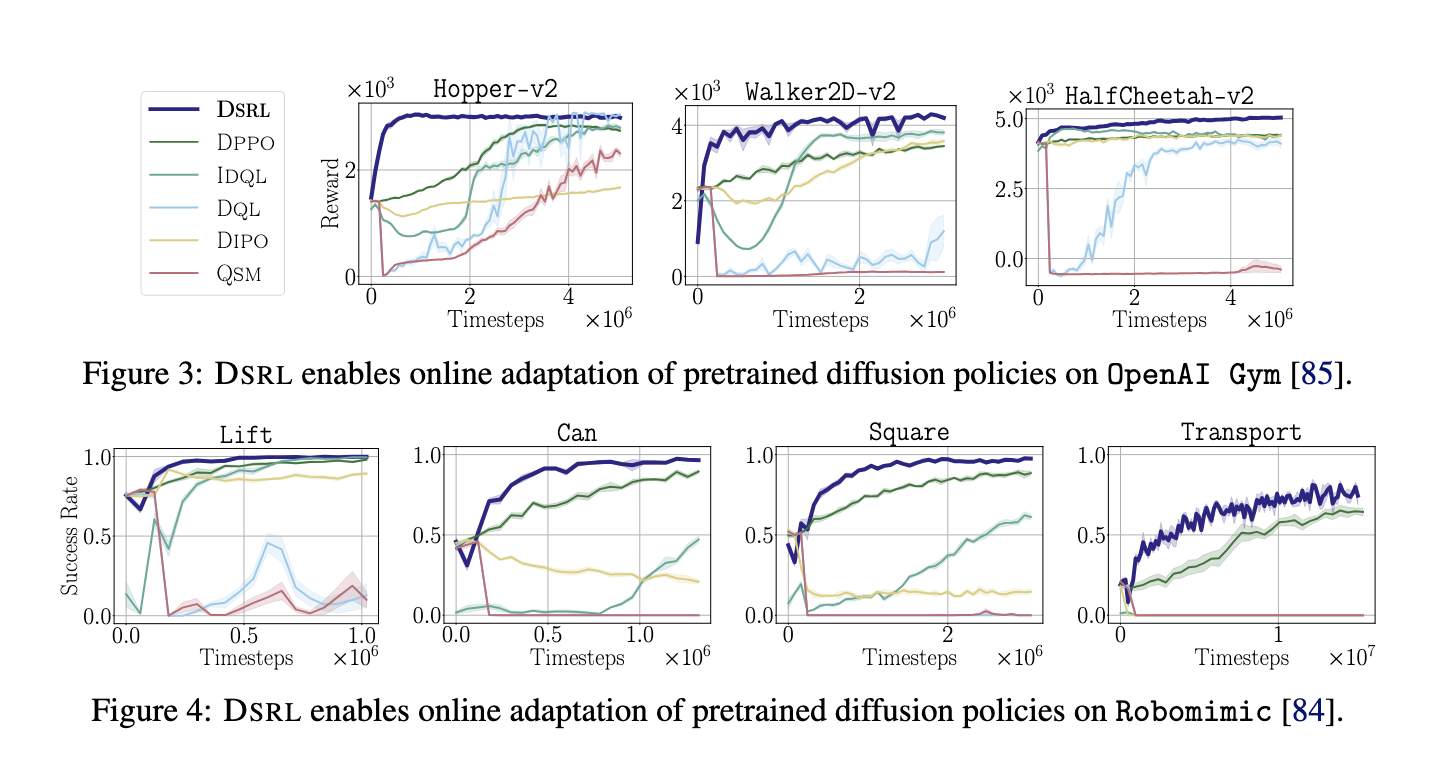
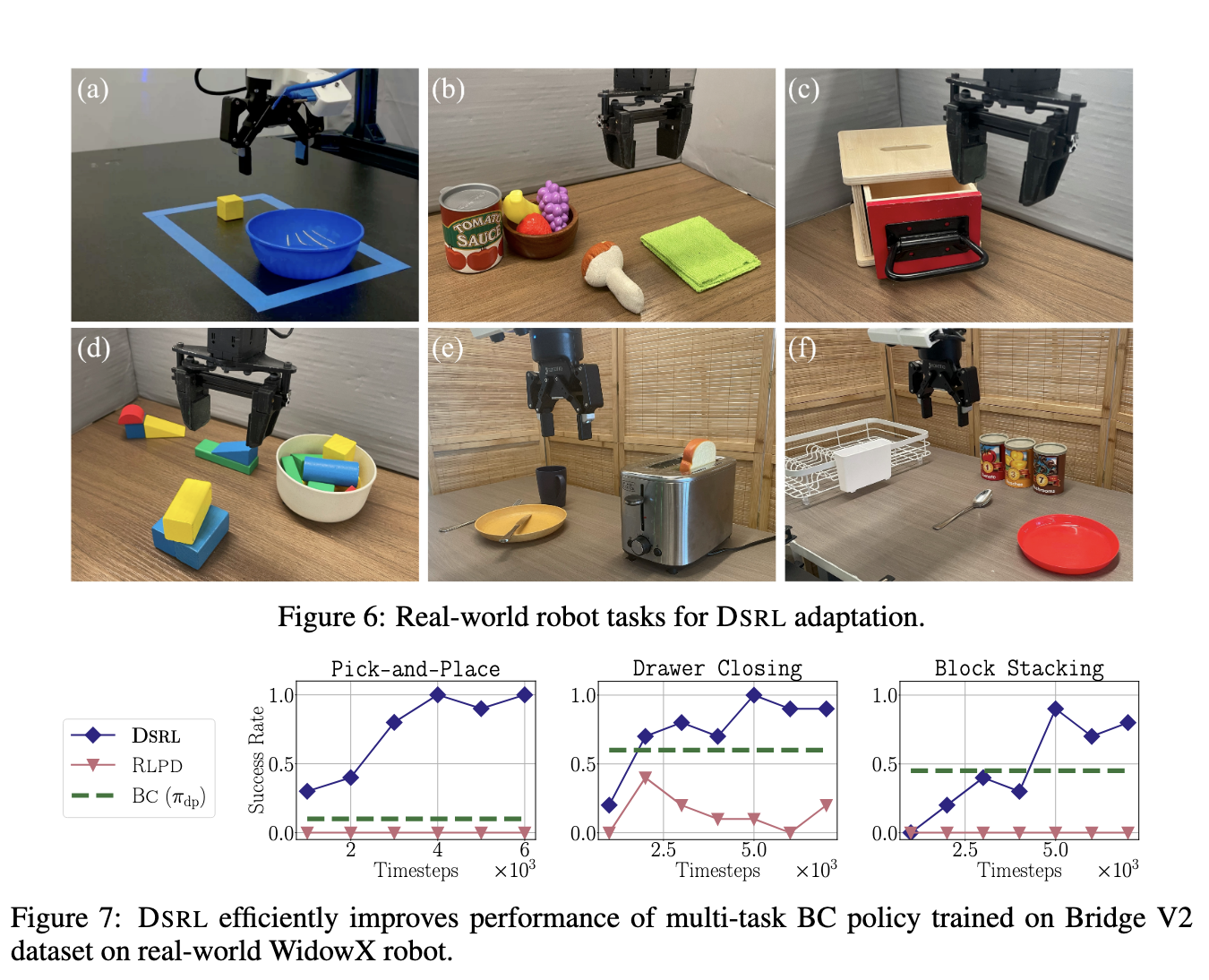
The method proposed showed significant improvements in data and performance efficiency. DSRL, for example, improved the task completion rate from 20% to 90% in a real-world robot task within less than 50 online interactions. The performance of the robot has increased by more than 4 times with only minimal information. The method was also tested on a generalist robotic policy named π₀, and DSRL was able to effectively enhance its deployment behavior. All of these results were achieved with no modification to the diffusion policy, or any access to its parameters. They demonstrate the method’s usefulness in limited environments such as API only deployments.
The conclusion of the article is:
Summary: The research has addressed the key issue of policy adaptation in robotics without extensive retraining, or accessing models directly. Incorporating a steering mechanism based on latent-noise, the team has developed an effective tool for robot learning in real world situations. The strength of the method lies in its stability, efficiency and compatibility, which makes it an important step forward for adaptable robot systems.
Take a look at the Paper You can also find out more about the following: Project Page. The researchers are the sole owners of all credit. Also, feel free to follow us on Twitter Don’t forget about our 100k+ ML SubReddit Subscribe Now our Newsletter.

Nikhil has been an intern consultant with Marktechpost. The Indian Institute of Technology in Kharagpur offers him a dual degree integrated with Materials. Nikhil, an AI/ML fanatic, is constantly researching AI/ML applications for biomaterials and other biomedical fields. Material Science is his background. His passion for exploring and contributing to new advances stems from this.

