


Today, most agentic software applications suffer from a problem with memory. Each time an agent opens a fresh session for a user, it starts at zero. The agent has no memory of the previous session, nor does it remember what had been discussed or which workflows are in process. Everything disappears when the session is over. The only solution for dev teams that are shipping production applications is to create a storage layer by hand, choosing a database, serializing states, managing session IDs and then connecting it into the agent runtime, before they write a line of product logic. It is a very powerful tool. Enterprise Intelligence Platform CopilotKit resolves this problem by providing an infrastructure managed by a layer which automatically handles memory and state. It works independently of the agent framework – any agent can have memory.
Give CopilotKit a ⭐ on GitHub
What is CopilotKit Enterprise Intelligence (EI)?
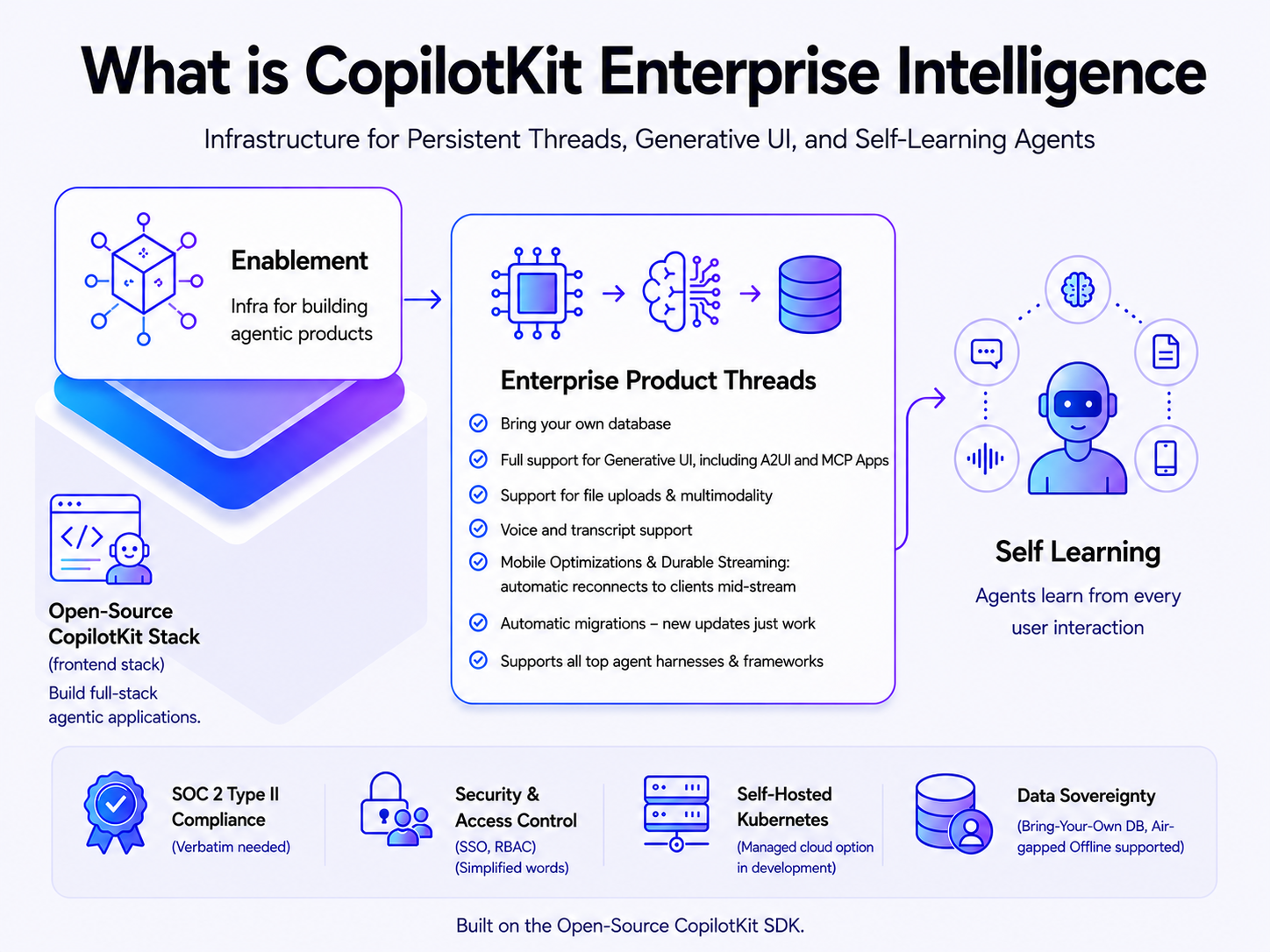
CopilotKit is the frontend stack for AI agents — production infrastructure for building Generative UI that lets users and agents collaborate directly inside the UI through interactive, stateful workflows.
The app supports A2UI, MCP, file uploads and voice transcription. It is designed for production, with features such as durable streaming (automatic reconnections in mid-stream), mobile optimizations and automatic migrations to ensure updates are frictionless. The software integrates seamlessly with major orchestration and agent frameworks.
The company is also behind the AG-UI (Agent-User Interaction) Protocol – a standardized solution that connects AI Agents to user-facing applications.
CopilotKit Enterprise Intelligence Platform (EIP) is a managed platform layer built on the CopilotKit Open-Source Stack. It doesn’t replace the SDK. The SDK lacks durable persistent memory, which is needed for agents to retain state and context. This can be done without the need to build storage infrastructure and independent of agent frameworks.
Platforms can self-host on Kubernetes. A managed cloud deployment is in the works. To meet enterprise security needs, the platform ships with SOC 2 Type II certification, SSO integration and role-based control. Additionally, license keys are validated to support air-gapped deployments. Self-hosted allows dev teams to use their own database, which preserves data sovereignty.
The core Primitive Thread
The main structural primitive of CopilotKit is the Thread. A Thread is an object of persistent first class that can be used by multiple users and devices. It is different architecturally from simply storing chat messages as a list in a database. CopilotKit’s Thread captures not only the exchange of text, but the entire interaction surface over time.
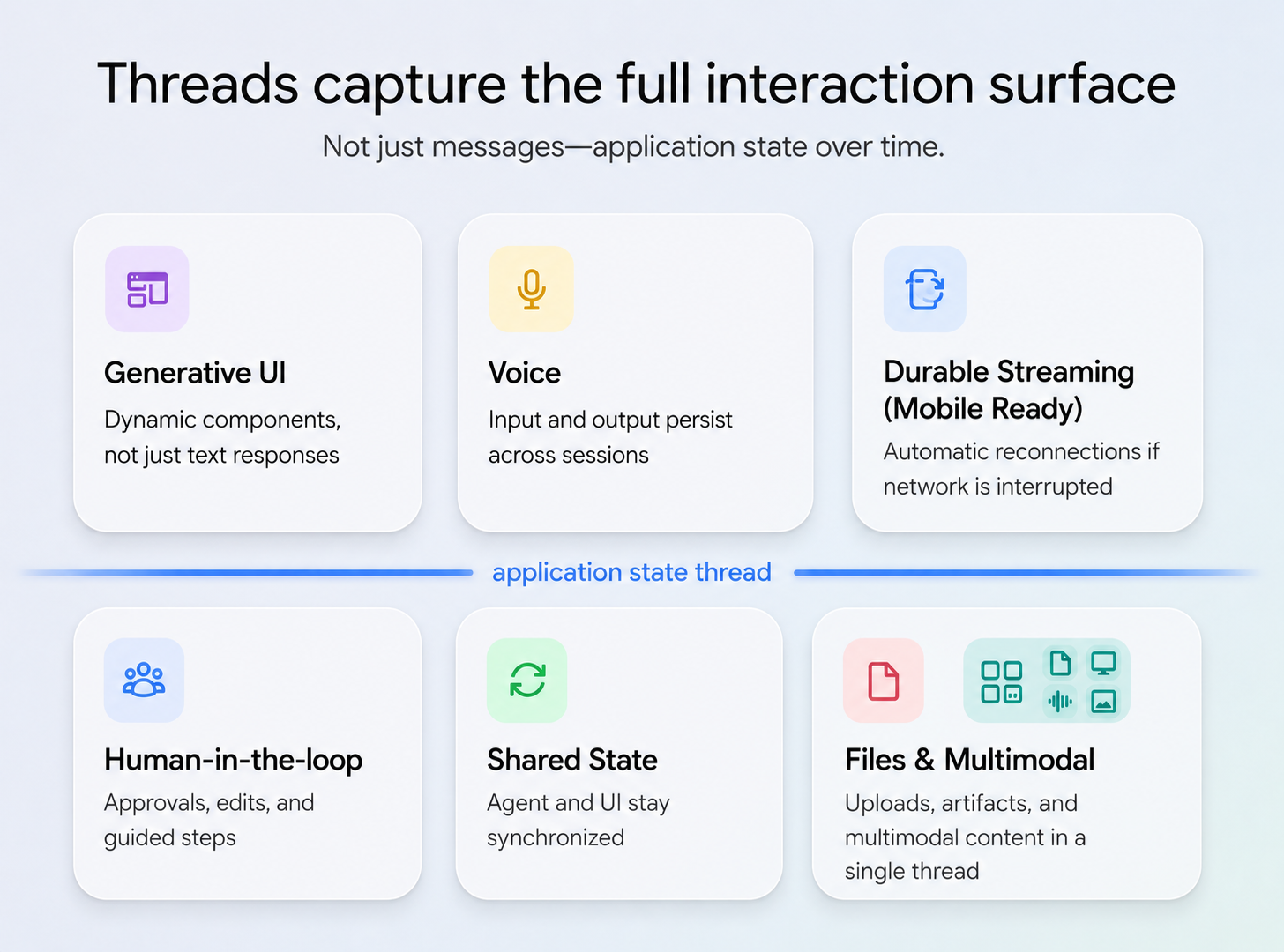
A Thread is composed of six types of interactions:
Generate UIThe dynamic UI components that are rendered on the fly by the Agent at runtime, and not only the text prompts which triggered them, will be captured.
Human-in-the-loop workflowsAs part of interaction trace, the user’s approvals or edits as well as guided decision-making steps are recorded.
Shared stateIt is possible to resume the session from a shared state, as the layer of synchronized states between the backend of the agent application and its frontend interface are recorded.
You can also call themBoth voice input and speech output persist between sessions. This is crucial for applications with agentic interfaces that use spoken language.
FilesThe Thread is preserved and does not lose any uploaded files, artifacts or output files.
Multimodal InteractionsRather than fragmented storage, text, UI, audio files, and other media are all stored within a single thread object.
In practice, this means agents can handle complex, long-running workflows—such as drafting legal documents or managing multi-step data pipelines—without the risk of state loss. The process that was started by a user on one device can be continued by another member of the team using a different device. These are crucial. Threads The logs aren’t just static; they contain structured objects which the runtime of an agent can directly read to keep continuity.
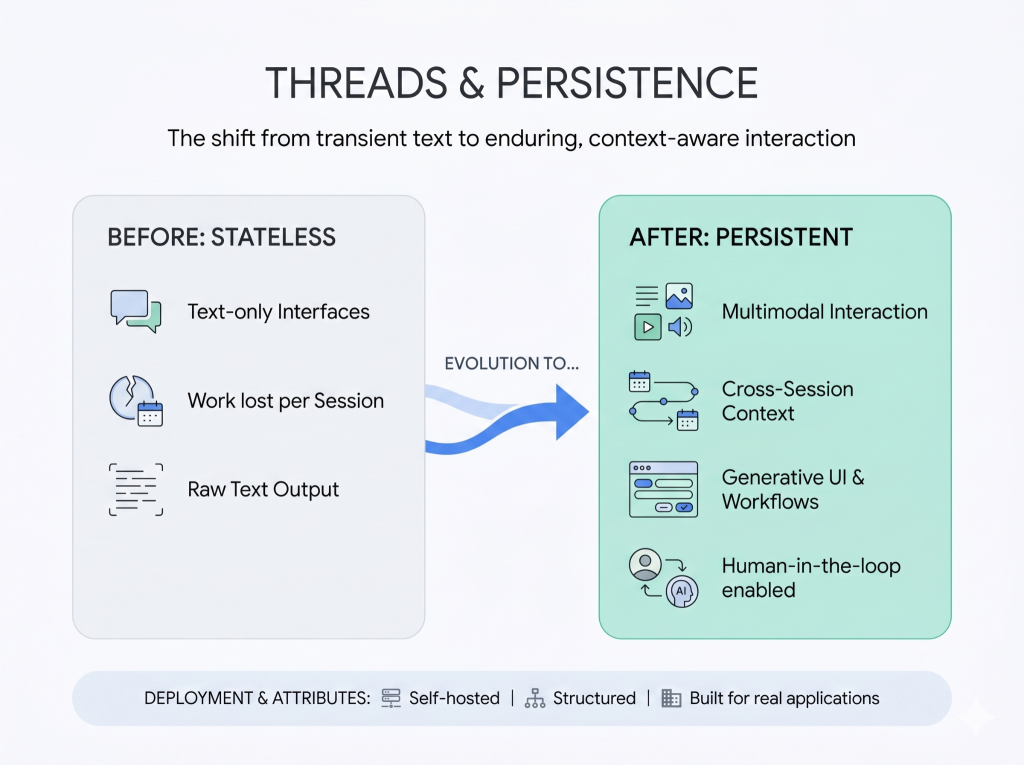
Before and After
CopilotKit’s team refers to the stateless default of agentsic applications, which is a stateless interface, with no structured UI beyond text and no memory between sessions. Work that was lost at the end of a session. With persistent Threads, the same application becomes structurally different — it has full interaction history over time, structured UI and action records, and the ability to resume across sessions with multimodal context intact by default.
This is particularly important when moving agentic applications from the demonstration to production. Demo environments do not require persistence, as a guided session will usually be enough to demonstrate capability. By definition, production applications involve return users, multiple-session workflows and state which needs to be preserved between interactions. Threads is the solution that allows teams to bridge this gap without having to build and maintain a custom memory infrastructure.
What is Next: Self-improvement and Analytics
Look ahead CopilotKit The platform is being expanded with the addition of two new capability layers. Analytics & Insights The following are some examples of how to get started: Self-Improvement. The analytics layer offers real-time data monitoring with dedicated dashboards. It also includes a SQL-queryable lakehouse with support for OTLP integration with DataDog. Simultaneously the Self Improvement layer will introduce Continuous Learning from Human FeedbackThe system uses prompt mutations and in-context reinforcements to fine tune agent behavior using live production signals. CopilotKit Intelligence turns every user interaction directly into an event of learning, bypassing the costly and lengthy data-labeling, fine-tuning, and labeling processes. Agents can then evolve independently within the production environments.
What you need to know
- CopilotKit Enterprise Intelligence Platform adds a managed layer to the CopilotKit open-source stack, allowing agents to retain their context, history, and state without having teams build custom storage infrastructure.
- Threads The core primitives are: persistent, first-class session objects which capture generative UI and human-in the-loop workflows. They also include shared state, audio, files and multimodal interaction across devices and sessions.
- It can also be deployed on a self-hosted Kubernetes platform with SOC 2 Type II certification, SSO, access-based role control and air-gapped support.
- It is important to note that the word “you” means “you”. Analytics & Insights The roadmap layer includes a dashboard in real time, a data lakehouse that can be queried using SQL, and OTLP observability exported to tools such as DataDog or NewRelic.
- You can also find out more about the following: Self-Improvement roadmap layer introduces Continuous Learning from Human Feedback (CLHF) with in-context reinforcement learning, prompt mutation, and per-user adaptation — improving agent behavior from production usage without fine-tuning.
References:
We would like to thank the Copilokit staff for their support in creating this article. The article was sponsored by Copilotkit.
