


Modern information retrieval systems are built on text embedding, reranking, and recommendation systems. These applications include semantic search, retrieval-augmented creation, and recommendation systems.RAG). However, current approaches often face key challenges—particularly in achieving both high multilingual fidelity and task adaptability without relying on proprietary APIs. Models are often inadequate in situations requiring nuanced understanding of semantics across languages, or tasks that require domain-specific knowledge such as code retrieval and instructions following. Most open-source APIs are expensive and limited in flexibility while most commercial models lack both.
Open-Source embedding standards: Qwen3-Embedding, Qwen3-Reranker.
Alibaba’s Qwen Team has unveiled the Qwen3-Embedding and Qwen3-Reranker Series—models that set a new benchmark in multilingual text embedding and relevance ranking. The series is based on Qwen3 Foundation models and includes variants with 0.6B and 4B parameter sizes. It also supports many languages, including 119 total. This makes it the most flexible and performant open source offering to date. The models have been open-sourced on Hugging Face and GitHub under an Apache 2.0 license. They are also available via the Alibaba Cloud APIs.
These models are optimized for use cases such as semantic retrieval, classification, RAG, sentiment analysis, and code search—providing a strong alternative to existing solutions like Gemini Embedding and OpenAI’s embedding APIs.
Architectural Technology
The Qwen3 embedding models use a transformer-based architecture and causal attention to produce embeddedings. They do this by obtaining the hidden states corresponding the the [EOS] token. Instruction-awareness is a key feature: input queries are formatted as {instruction} {query}The embeddings are task-conditioned. Reranker models can be trained in a binary classifier format and are then used to score document queries using token likelihood scores.
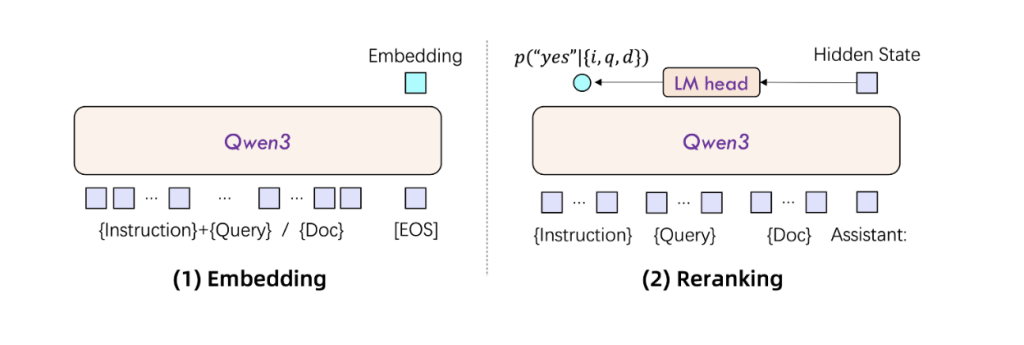
A robust pipeline for multi-staged training is used to train the models:
- Large-scale weak supervision: Qwen332B generated 150M pairs of synthetic training pairs covering STS, retrieval and classification across all languages, tasks and languages.
- Fine-tuning under supervision: 12M high-quality data pairs are selected using cosine similarity (>0.7), fine-tuning performance in downstream applications.
- Model merging: This robustness is achieved by using a spherical interpolation of finely-tuned checks.
This synthetic data generation pipeline enables control over data quality, language diversity, task difficulty, and more—resulting in a high degree of coverage and relevance in low-resource settings.
Performance Insights and Benchmarks
Qwen3 embedding and Qwen3 reranker show strong performance on several benchmarks.
- MMTEB With 216 tasks in 250+ languages, Qwen3Embedding-8B has a task average of 70.58Gemini and GTE Qwen2 Series are obsolete.
- On MTEB (English v2): Qwen3Embedding-8B can reach 75.22NV-Embed v2 & GritLM-7B, as well as other open models.
- On MTEB: Qwen3 embedding-8B has a lead with 80.68Stack Overflow QA and code retrieval are two of the most popular applications.
The reranking of a score:
- Qwen3 Reranker-0.6B is already better than Jina rerankers and BGE rerankers.
- Qwen3-Reranker-8B achieves 81.22 MTEB code and 72.94 MMTEB-R is the new benchmark for performance.
The need for each stage of training is confirmed by ablation studies. The performance drop (up to six points) when removing synthetic pretraining and model merging was significant.
The conclusion of the article is:
Alibaba’s Qwen3 Series, Qwen3 Reranker, and Qwen3 Embedder provide an open and robust solution to semantic representation in multilingual contexts. The models are able to bridge the gap that exists between proprietary APIs, as well as open-source accessibility, with their strong empirical findings across MTEB (Multilingual Text Encoding), MMTEB (Multilingual Multi-Tension Encoding) and MTEB Code. Their thoughtful training design—leveraging high-quality synthetic data, instruction-tuning, and model merging—positions them as ideal candidates for enterprise applications in search, retrieval, and RAG pipelines. Open-sourcing the models allows the Qwen Team to not only advance the frontiers of language understanding, but empower the wider community with a solid base.
Take a look at the Paper, Technical details, Qwen3-Embedding The following are some examples of how to get started: Qwen3-Reranker. This research is the work of researchers. Also, feel free to follow us on Twitter Don’t forget about our 95k+ ML SubReddit Subscribe now our Newsletter.

Asif Razzaq serves as the CEO at Marktechpost Media Inc. As an entrepreneur, Asif has a passion for harnessing Artificial Intelligence to benefit society. Marktechpost is his latest venture, a media platform that focuses on Artificial Intelligence. It is known for providing in-depth news coverage about machine learning, deep learning, and other topics. The content is technically accurate and easy to understand by an audience of all backgrounds. Over 2 million views per month are a testament to the platform’s popularity.
