

OpenAI just made a huge impact on the AI industry: For the first time, since GPT-2 was released in 2019, OpenAI is releasing TWO language models with open weight. Meet gpt-oss-120b You can also find out more about the following: gpt-oss-20b—models that anyone can download, inspect, fine-tune, and run on their own hardware. The launch of this project is not just a shift in the AI landscape, but also a new age of customization and computational power. This will benefit researchers, developers and enthusiasts alike.
Why is this release a big deal?
OpenAI is known for its fortress-like proprietary technology and jaw-dropping models. This changed on August 5th, 2025. The new models will be distributed in accordance with the permissive Apache 2.0 licenseMaking them available for experimental and commercial use. What’s the difference? The difference is that instead of hiding behind cloud-based APIs Anyone can use this can now put OpenAI-grade models under their microscope—or put them directly to work on problems at the edge, in enterprise, or even on consumer devices.
The Models: Real Muscle and Technical Wonders
gpt-oss-120B
- Size: There are 117 trillion parameters, with 5.1 billion of them active for each token (thanks to the Mixture of Experts Tech).
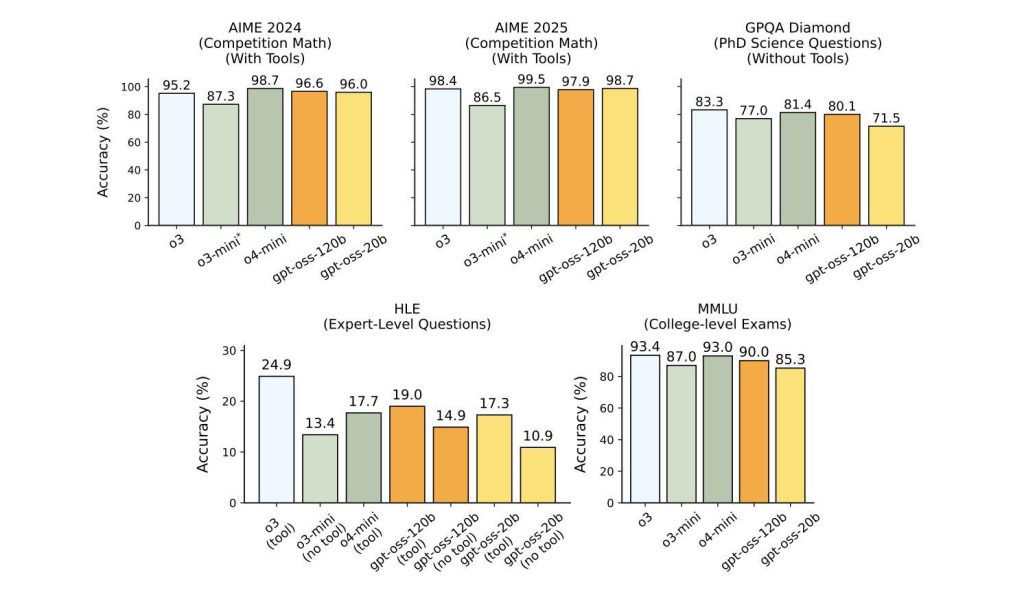
- Performance: OpenAI o4 mini or higher in real world benchmarks.
- Hardware: Runs on a single high-end GPU—think Nvidia H100, or 80GB-class cards. There is no need for a server farm.
- Reasoning: Features chain-of-thought and agentic capabilities—ideal for research automation, technical writing, code generation, and more.
- Customization: Supports are configurable “reasoning effort” You can adjust the power level to suit your needs (low, medium or high) and save energy when not needed.
- Context: Handles up to a massive 128,000 tokens—enough text to read entire books at a time.
- Fine-Tuning: Built for easy customization and local/private inference—no rate limits, full data privacy, and total deployment control.
gpt-oss-20B
- Size: The tokens have a total of 21 billion parameters, with 3.6 billion parameters active per token (also Mixture of Experts).
- Performance: Sits squarely between o3-mini and o4-mini in reasoning tasks—on par with the best “small” models available.
- Hardware: Runs on consumer-grade laptops—with just 16GB RAM or equivalent, it’s the most powerful open-weight reasoning model you can fit on a phone or local PC.
- Mobile Ready: Specific optimized for low-latency private AI on devices (including Qualcomm Snapdragon Support), Edge Devices, and other scenarios that require local inference without the cloud.
- The Agentic Powers of the Mind: The 20B is a big brother of the bigger sibling. It can also use APIs to generate structured outputs and run Python code when needed.

The Mixture of Experts (MXFP4) and its Quantization
Both models use a Mixture-of-Experts (MoE) Architecture, activating only a few “expert” Subnetworks for tokens The results? Enormous parameter counts with modest memory usage and lightning-fast inference—perfect for today’s high-performance consumer and enterprise hardware.
Add to That native MXFP4 quantizationModel memory footprints are reduced without any loss of accuracy. The 120B version fits perfectly onto one advanced GPU, while the 20B can be used on desktops, laptops and mobile hardware.
Tools with Real-World Effects: Enterprises, Hobbyists and Developers
- For Enterprises: For data security and compliance, on-premises deployment is recommended. Cloud AI is no longer a black box: the legal, financial and healthcare sectors now have full control and security over their LLM workflow.
- To Developers: The freedom to tweak, refine, and expand. There are no API limitations, and there is no SaaS bill. Just pure AI that can be customized with complete control of latency or costs.
- The Community: Models are already available on Hugging Face, Ollama, and more—go from download to deployment in minutes.
How does GPT-OSS compare?
The kicker is: The first free-to-use open-weight model to match the performance of commercial top models, such as o4 Mini.. The 20B version will not only close the gap in performance for AI on devices, but also accelerate innovation. It is likely to push the boundaries of what can be done with LLMs.
It’s the Future (Again).
OpenAI’s GPT OSS isn’t just a release, it’s a call to action. By making state-of-the-art reasoning, tool use, and agentic capabilities available for anyone to inspect and deploy, OpenAI throws open the door to an entire community of makers, researchers, and enterprises—not just to use, but to build on, iterate, and evolve.
Click here to find out more gpt-oss-120B, gpt-oss-20B You can also find out more about the following: Technical Blog. Check out our website to learn more. GitHub Page for Tutorials, Codes and Notebooks. Also, feel free to follow us on Twitter Join our Facebook group! 100k+ ML SubReddit Subscribe Now our Newsletter.

Asif Razzaq, CEO of Marktechpost Media Inc. is a visionary engineer and entrepreneur who is dedicated to harnessing Artificial Intelligence’s potential for the social good. Marktechpost is his latest venture, a media platform that focuses on Artificial Intelligence. It is known for providing in-depth news coverage about machine learning, deep learning, and other topics. The content is technically accurate and easy to understand by an audience of all backgrounds. Over 2 million views per month are a testament to the platform’s popularity.
